

Why the Hydroplate Theory?
Many people often wonder about the Hydroplate Theory, especially after learning its details. This leads to a common question: Why the Hydroplate Theory? When I think of this question, two prominent string theorists come to mind. The first is Leonard Susskind, a leading figure in modern string theory, often referred to as the "Bad Boy of Physics"—though the meaning of that title is up for debate. Susskind emphasizes the importance of "following where the physics leads us," even if it takes us to uncomfortable or unexpected conclusions. These might include concepts like an "accidental" universe, the holographic principle, or the vast landscape of string theory. The Hydroplate Theory can provoke similar feelings of discomfort. I reflect on Susskind's belief that our existence might just be two-dimensional information projected from the event horizon of a black hole. In comparison, I ask myself, "Is Hydroplate Theory really that outlandish?" The answer is no; it's not even close. In fact, the Hydroplate theory follows the same rigorous journey where physics leads us—starting from a literal interpretation of the Bible.
For the wisdom of this world is foolishness with God. For it is written, He taketh the wise in their own craftiness.

Two different starting points
In the Children's book "Where did the Dinosaurs go? by Curtis Hammitt. Dad explains the two different starting points to his children.
"Then Dad added, "These two belief systems will create two distinct initial conditions for the Earth. Those who believe the universe originated from some universe that they imagine can exists outside of this universe and that the Earth was formed in a fiery state, similar to what we imagine hell to be like, and that humanity emerged through the death of other organisms. Conversely, those who believe that God created the Earth in six literal days contend that it began in a perfect and pristine state, free from death, where God walked alongside humanity. Therefore, the type of atmosphere necessary for the dinosaurs to have existed would also reflect the Earth's most pristine condition. The differences between these two belief systems are stark, which explains the ongoing conflict between them.""
This indicates that Christian six-day creation theories cannot coexist with materialist views. Materialists contend that matter and energy are the only constituents of the universe.
But their minds were blinded. For until this day the same veil remains unlifted in the reading of the Old Testament, because the veil is taken away in Christ.
When discussing string theory, Brian Greene often emerges as a notable figure. I would describe him as the "ambassador" of string theory, given his extensive efforts to popularize the subject through documentaries and numerous interviews. In his NOVA special, "The Fabric of the Cosmos: Universe or Multiverse?", he makes a compelling observation: when multiple theories converge towards a common conclusion, it strongly suggests that this is the direction you should be exploring.
He believes that we do not inhabit a single universe, but rather an infinite multiverse, teeming with countless universes. This concept implies the existence of an infinite number of Curtis Hammitts, each slightly different from the others. Perhaps, in some distant universe, there exists a Curtis Hammitt who is not annoying. While I doubt it, the possibility is certainly intriguing.
Pillars of the Hydroplate Theory


Many wonder how we can challenge the ideas of these world-class scientists. The truth is, anyone can be mistaken if they begin their analysis from a faulty premise. Consider this analogy: when playing catch, you must throw the ball in the direction of your partner. If your eyes are closed or obscured, you risk throwing the ball over a cliff rather than to the person standing behind you.
People want us to believe that we are holograms or that there exists an infinite number of Curtis Hammitts scattered throughout the multiverse? This desire reminds me of a well-known passage from Shakespeare's "The Merchant of Venice," adapted slightly for clarity:
"I am a human. Do not humans have eyes? Do we not have hands, organs, dimensions, senses, affections, and passions? Are we not fed by the same food, harmed by the same weapons, susceptible to the same illnesses, and healed by the same remedies? Do we not experience the same warmth of summer and the chill of winter, just as a physicist does? If you prick us, do we not bleed? If you tickle us, do we not laugh?"
We are all human; we can look at our hands and see they are not holograms. We experience a singular reality, not multiple ones. Critics might argue that this perspective is oversimplified. They might point out that while we cannot see atoms directly, we accept their existence. This belief, however, is grounded in experiments that we can conduct ourselves. For instance, when we sprinkle pepper on water, we can observe the Brownian motion that Einstein used to validate the existence of atoms. Similarly, if I believe that God created this universe, it aligns perfectly with what I observe.
What Separates the Hydroplate theory from the other theories.
The Hydroplate theory operates on initial conditions that differ significantly from those of the previously outlined secular theories. Prior to the flood, the Earth was under a curse, yet the deluge had not yet come to pass. As noted in Genesis 6:13, God declared the destruction of both the Earth and humankind. Since the Earth had not been obliterated, its state before the flood was markedly different from what it became afterward. The Earth and its atmosphere were much closer to a "very good" condition than what we witness today. This pristine state not only represented a flourishing environment but also contained the potential energy necessary for the flood and the subsequent devastation of the Earth.
Brian Greene suggested that when multiple theories converge on a single concept, it serves as a strong indicator that the truth may lie within that direction. He elaborates on three theories that bolster the multiverse hypothesis. Similarly, I will outline three theories that lend support to the Hydroplate theory, though there are many more to consider.
- Predictions derived from the Hydroplate theory
- The heterogeneous layers in the Earth’s mantle
- Geological features observed on Mars
Hydroplate Theories Predictions


Any theory is strengthened when it successfully makes predictions. The reason why this is true is that to say that the theory is not correct, it must be explained why this theory makes accurate predictions. Mendeleev proved the periodic law by using it to make accurate predictions about undiscovered elements. When these elements were discovered, it proved that Mendeleev's Periodic Law was correct. Dr. Brown made numerous predictions, and many of those predictions have been proven to be accurate.
A few of the predictions:
PREDICTION 12: When greater precision is achieved in measuring the inner core’s rotational speed, it will be found to be slowing relative to the rest of the Earth.
A 2023 study aids the following: Evidence for the differential rotation of the Earth’s inner core was first reported from temporal changes of the seismic waves traversing it over years or decades from the South Sandwich Islands (SSI) to the College seismic station in Alaska
Yi Yang and Xiaodong Song, “Multidecadal Variation of the Earth’s Inner-Core Rotation,” Nature Geoscience 16, no. 2 (February 2023): 182–87, https://doi.org/10.1038/s41561-022-01112-z.
PREDICTION 29: Craters on the moon were caused by material launched from Earth by the Fountains of the Great Deep.
This prediction was first published in 2001 and has been confirmed by multiple findings of rocks, water, and gases on the moon. One of these studies concluded that a rock brought back from the moon formed in a water-rich environment 19 km below the surface of the Earth.
PREDICTION 30: Soil in “erosion” channels on Mars will contain traces of earthlike soluble compounds, such as salt, from Earth’s pre-flood subterranean chambers. Soil far from “erosion” channels will not.
Reference : (This prediction was first published in April 2001. Salt was first discovered on Mars in March 2004.93)
“The presence of hydrated minerals on the surface of Mars implies that the crust was once altered by the action of liquid water. … the degree of alteration of the ancient martian crust is more extensive than previously assumed.”
J. Carter et al., “Detection of Hydrated Silicates in Crustal Outcrops in the Northern Plains of Mars,” Science, Vol. 328, 25 June 2010, pp. 1610. See also pp. 1682–1686.
These and many of the predictions about comets and asteroids have already been verified.
What Separates the Hydroplate theory from other theories

Sharkov, E.. (2011). The Earth's core formation and development: evidence from evolution of tectonomagmatic processes and paleomagnetic data. AGU Fall Meeting Abstracts. 0024-.
The hydroplate theory can best explain the diverse composition of the Earth's mantle, as all other theories rely on plate tectonics to describe it. When we refer to a heterogeneous mantle, we mean that it consists of distinct layers, each made up of different types of rock. Consequently, each layer has a unique chemical composition.
Plate tectonics explains that the mantle is the region where oceanic plates, composed of basalt, either subduct or are forced downward into the mantle, while magma plumes ascend toward the surface. These processes occur in tandem, as subducting plates and magma plumes work together. To visualize this, imagine the mantle as a water bed: when pressure is applied to one area, it causes a rise in another. It is believed that tectonic plates are in a continuous state of sinking and rising, which effectively mixes the chemical composition of the mantle. Therefore, we should expect to find a homogeneous mantle rather than a heterogeneous one.
The question of whether tectonic plates and particularly plumes can penetrate the transition zone remains a topic of debate. According to the Hydroplate theory, this transition zone lies beneath what is termed the crossover depth. At this depth, if rock transitions to a liquid state, it becomes denser than the surrounding solid rock, causing it to sink. Geologists refer to this boundary as the bottom of the upper mantle, while the Hydroplate theory identifies it as the crossover depth. The transition zone, as defined by geologists, extends from the bottom of the upper mantle to the top of the lower mantle.
If plumes originate from the lower mantle and ascend to the upper mantle before reaching the surface, one might expect the entire mantle to be homogeneous. However, observations suggest otherwise. The mantle appears to be heterogeneous, indicating that these plumes have not effectively blended the different layers.
Notably, only the Hydroplate theory accounts for the heterogeneous nature of both the upper and lower mantle.
What's Mars have to do with it?
One common question found on nearly every standardized Earth Science test is: "Which planet boasts the largest volcano in the solar system?" The answer is Mars. But there's more to it—this incredible volcano is not only the largest of its kind in the solar system; it also resides within the vastest igneous province known in the solar system.
Catastrophic plate tectonics suggests that God created Mars with five massive volcanoes on the Tharsis plateau. These volcanoes erupted, briefly producing an atmosphere on the planet. For this to happen, enormous volumes of magma would have needed to rise from Mars' interior, erupting through the volcanoes to form Olympus Mons and the Tharsis plateau.
Both secular astronomy and the CPT theories suggest that the volcanoes and the Tharsis plateau developed in a similar manner. The primary distinction lies in the duration required for this formation. However, there are two key issues with this mechanism.
- The buoyance force on Mars would be even lower than the buoyance force on Earth because of Mars low gravity. This low buoyant force would make accent to the surface through solid rock impossible.
- Mars features a crust with remarkably low density. Plumes typically rise because they are less dense than the surrounding rock. However, in the case of Mars, the plume would not be less dense than its low-density crust. As a result, the plume would halt its ascent and fail to reach the surface.
The Hydroplate Theory presents a distinct mechanism. Mars is home to approximately 635,000 meteorite craters, each measuring 1 km in diameter or more. According to this theory, all of these meteorites impacted the planet within a single year, propelled from Earth during the catastrophic flood. The following excerpt from "Yes, Victoria, Noah's Worldwide Flood Did Occur" elaborates on this phenomenon.
There are 635,000 impact sites on Mars that exceed one kilometer in diameter. The Hydroplate theory posits that these impacts all transpired within a single year following their ejection from Earth. Such a high volume of impacts would have resulted in an average increase in the temperature of the Martian crust by approximately 300 K, assuming the meteorites were traveling at a velocity of 10 km/s; this temperature rise could escalate to as much as 700 K if the meteorites were moving at 50 km/s.
Significantly, two of the largest known impact craters in the solar system are located directly opposite the Tharsis Plateau, at its antipodal point. The Tharsis Plateau is distinguished as the site of the largest volcanoes in the solar system.
Olympus Mons was formed through the extrusion of approximately 2 million cubic kilometers of molten material, contributing to the extensive geological features observed on the Tharsis Plateau, which encompasses a total of 9 million cubic kilometers of melt. In his calculations, Dr. Melosh utilized a heat of fusion value of 330 kJ/kg for the Martian rocks. This assessment indicates that an energy input of 8.61 × 1024 joules would be required to generate the magma that constitutes the Tharsis Plateau.
Furthermore, should a mere ten-thousandths of the energy released from the impact events reach the antipodal point, this fraction would suffice to provide sufficient thermal energy to melt the rock necessary for the formation of Olympus Mons and the surrounding regions of the Tharsis Plateau.
The consequences of these impacts could also lead to rainfall on Mars. Here’s another quote from "Yes, Victoria, Noah's Worldwide Flood Did Occur."
The recently proposed hydroplate theory posits that an estimated 635,000 comets and asteroids impacted Mars within a time frame of one year or less subsequent to the event commonly referred to as the "waters of the deep." These celestial collisions are calculated to have imparted an energy range between 2.5 x 1030 to 5 x 1030 joules to the Martian surface, a magnitude ten million times greater than the energy released by the comet believed to have caused the extinction of the dinosaurs.
If one considers that these 635,000 comets collectively delivered approximately 7 x 10²⁰ kg of water to Mars, it follows that the average mass of each comet would be around 1 x 10¹⁵ kg. By contrast, the object responsible for the extinction event on Earth would have possessed a mass three times greater than that of these comets and asteroids. This significant influx of water has the potential to have inundated Mars to a depth of 4.8 kilometers.
The impacts on Mars would have significantly elevated atmospheric pressure to levels ranging from 1,000 to 2,000 kPa. For context, the average atmospheric pressure on Earth is 101 kPa, suggesting that post-impact pressures on Mars may have been approximately twenty times that of Earth. The immense heat generated from these impacts, with an estimated energy release between 1.5 and 5 x 1030 J, could have raised the temperature of the Martian atmosphere to between 400 and 600 K, a condition that might have endured for centuries. The combination of elevated temperatures and pressures would have catalyzed intense, global precipitation, potentially ranging from 5 to 20 meters annually. This continuous rainfall could have resulted in extensive mudflows and the formation of substantial ponds, persisting for over a millennium. Consequently, oceans and lakes may have formed, reaching depths of 5 to 10 kilometers, with the heavy rainfall contributing to an intricate network of river systems carved into the Martian landscape.
The absence of water on Mars can be attributed to a phenomenon known as the "runaway icehouse" effect. As precipitation occurred, rain would have sequestered atmospheric gases, leading to a cooling of the atmosphere. This cooling effect would have perpetuated a cycle of increased precipitation, ultimately resulting in a decline in surface temperatures and the gradual loss of the atmosphere. Consequently, the existing water would have transitioned to a gaseous state and dissipated into space.
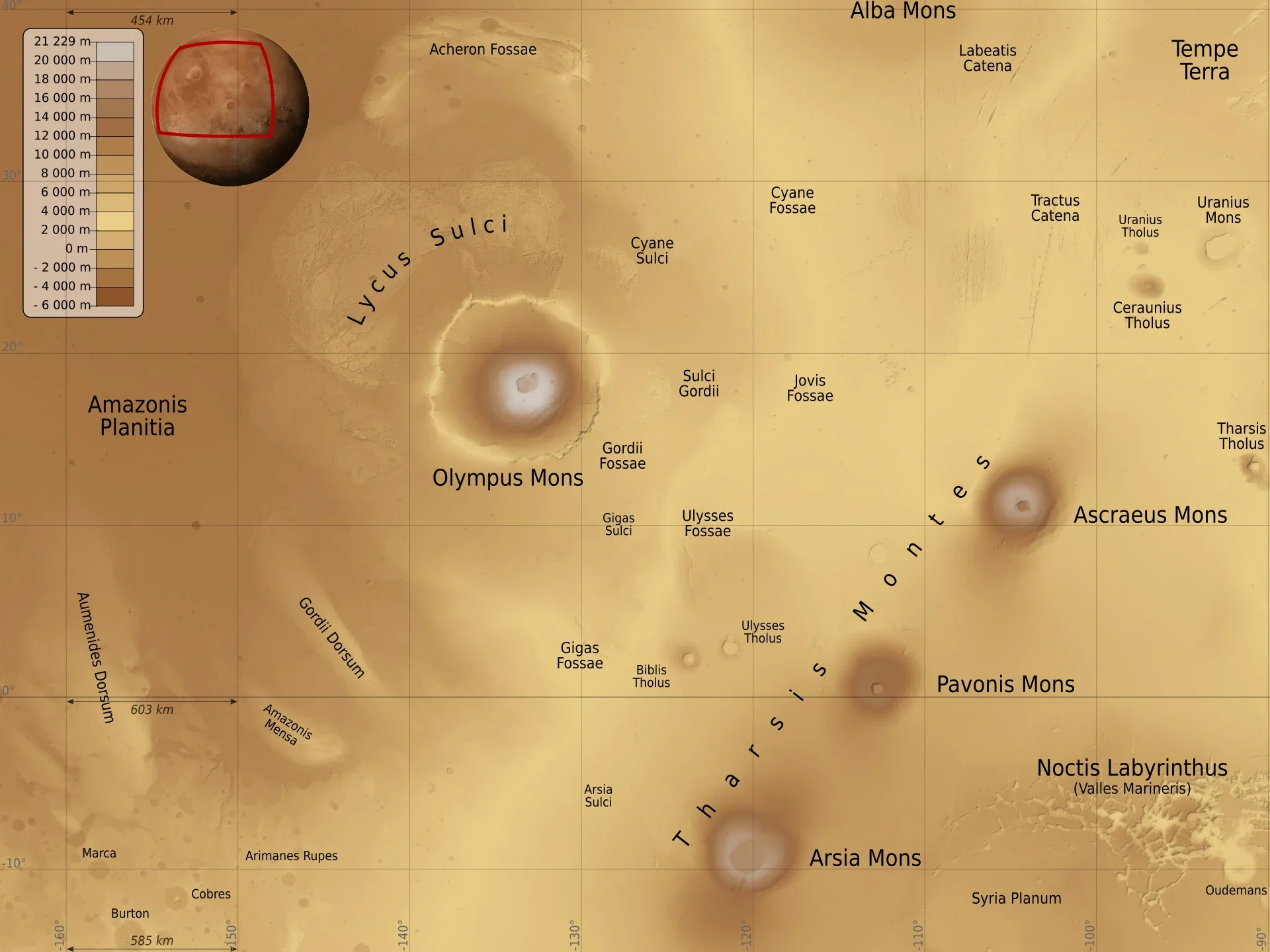
Sémhur, 7 July 2009, This file is licensed under the Creative Commons Attribution-Share Alike 4.0 International, 3.0 Unported, 2.5 Generic, 2.0 Generic and 1.0 Generic license

This file is in the public domain in the United States because it was solely created by NASA. NASA copyright policy states that "NASA material is not protected by copyright unless noted".

Hellas crater measures 2300 km in diameter in blue. The Tharsis plateau in red is 2700 km in diameter.
Isidis Crater in light blue has a diameter of 1400 km.
The Hydroplate Theory
Current research indicates that planets classified as ocean worlds may constitute up to 35% of all known planets, with some exoplanets exhibiting water compositions of up to 50%. Prior to historical events such as the Great Flood, Earth may have been considered a quintessential water world. Astronomers have identified the presence of exocomet belts surrounding various solar systems. Notably, these belts typically appear to form at distances ranging from 10 astronomical units (au) to 100 au from their respective host stars. In comparison, the objects within the Kuiper Belt are located approximately 30 au to 55 au from the Sun. It is particularly noteworthy that these belts appear to be closely associated with water-rich planetary systems, or ocean worlds. This raises intriguing questions: do ocean worlds in other solar systems have the capacity to produce comets? For instance, Saturn's moon Enceladus is known to eject water over 9,000 kilometers from its surface. The resultant particles contribute to the formation of one of Saturn's rings. Consequently, it provokes inquiry into how much farther a planet, with a mass 55,000 times greater, could potentially launch water into space. This posits that the phenomenon of Earth propelling rock and water into space—thereby contributing to the formation of a Kuiper-like belt—may not be as rare within the universe as previously assumed. FEBs in the following quote are exocomets.
The stars hosting FEBs are on average 70 Myr younger than the stars hosting no FEBs— although one has to consider that obtaining accurate ages for A-stars is still problematic. They also could not find a statistically significant difference between stars based on their metallicity or chemical peculiarity. In the observed sample, the FEB hosting stars are of an earlier type which, as argued by the authors, could be due to stellar activity. The detection of an FEB event itself strongly depends on the viewing the angle of the disk (which must be close to edge on) and the observational time frame (i.e., lower levels of activity need longer timespans of observation). They conclude that the detection of FEB activity can also be seen as evidence for the presence of associated exoplanets.
Dina Prialnik, M. Antonietta Barucci, and Leslie A. Young, The Trans-Neptunian Solar System (Amsterdam: Elsevier, 2020). pp 334
At this point in time this is just an interesting observation.
The Hydroplate Theory uniquely positions itself as a comprehensive model capable of elucidating distinctive features within our solar system, particularly those observed on Mars. Dr. Susskind asserts the importance of adhering to the principles of physics, even when they lead to conclusions that may appear uncomfortable or unexpected. We would posit that such inquiries should begin with a theological framework that considers God as the initial creator, a perspective that could significantly alter many of Dr. Susskind's theories. (This topic, however, merits exploration in a separate publication.) By following the implications of the physics in light of divine creation, as presented in the narrative of six twenty-four-hour days. The Hydroplate Theory remains unparalleled in its capacity to describe not only the Earth but also the solar system in which we reside.